
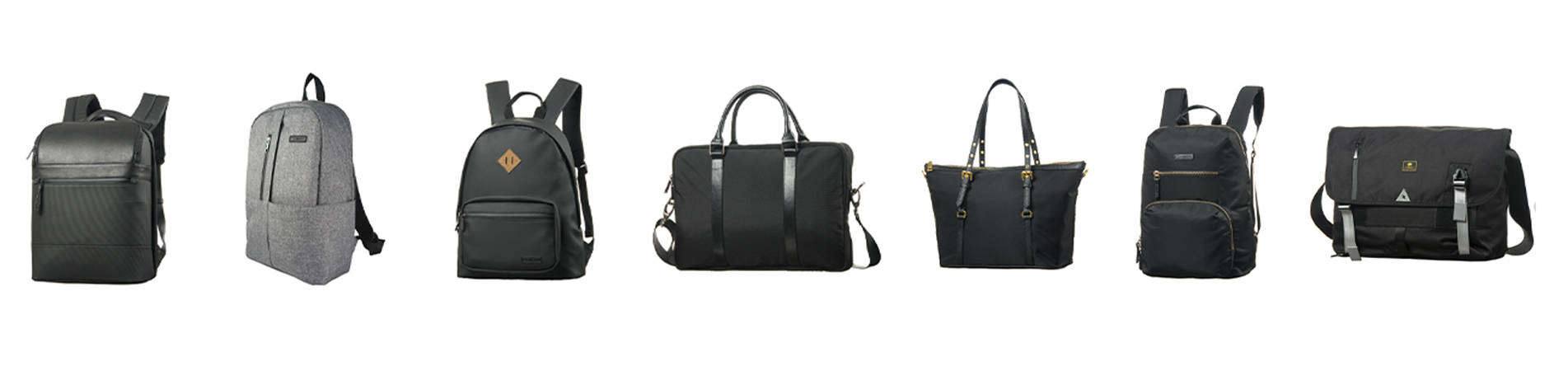
GRS (Global Recycled Standard) is an international, voluntary product standard developed by Textile Exchange. The standard is designed to verify the recycled material content of products and ensure the traceability of these materials throughout the entire supply chain.
At the same time, GRS also covers requirements related to social responsibility, environmental management, and chemical restrictions, to ensure that the production process of recycled products complies with environmental and ethical standards. In short, obtaining GRS certification means that the product not only contains a certain percentage of recycled materials, but also that the entire production process has undergone rigorous third-party auditing and meets relevant sustainable development requirements.
For bag OEM purchasers, understanding GRS certification is not only a reflection of choosing environmentally friendly materials, but also a key measure to mitigate supply chain risks and meet brand compliance requirements. By purchasing GRS-certified products, brands can ensure that upstream suppliers meet international standards in areas such as raw material traceability, labor rights protection, and pollutant emissions, thereby effectively addressing increasingly stringent international trade barriers and consumers’ expectations for transparent production.
In addition, GRS-certified bag products can help enhance brand image, strengthen market competitiveness, and provide brands with a more compelling sustainability narrative.

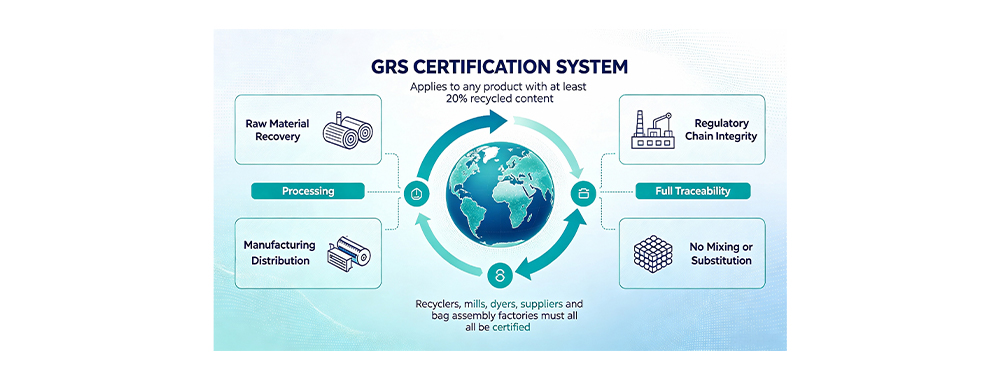
The GRS standard applies to any product containing at least 20% recycled materials. Its scope is not limited to the textile industry, but broadly covers the entire supply chain, from raw material recovery, processing, and manufacturing to the distribution of finished products.
According to Textile Exchange, qualified recycled materials are mainly divided into two categories: Post-Consumer Recycled (PCR) materials and Post-Industrial Recycled (PIR) materials.
In the bag industry, GRS-certified materials come in various forms, mainly including:
The GRS standard places particular emphasis on the integrity of the Chain of Custody, requiring all companies involved in the production process—including recyclers, spinning mills, weaving mills, dyeing and printing factories, accessory suppliers, and final bag assembly factories—to obtain GRS certification. This ensures that recycled materials are not mixed up or replaced during the transfer process, thereby achieving full traceability from the source to the finished product.
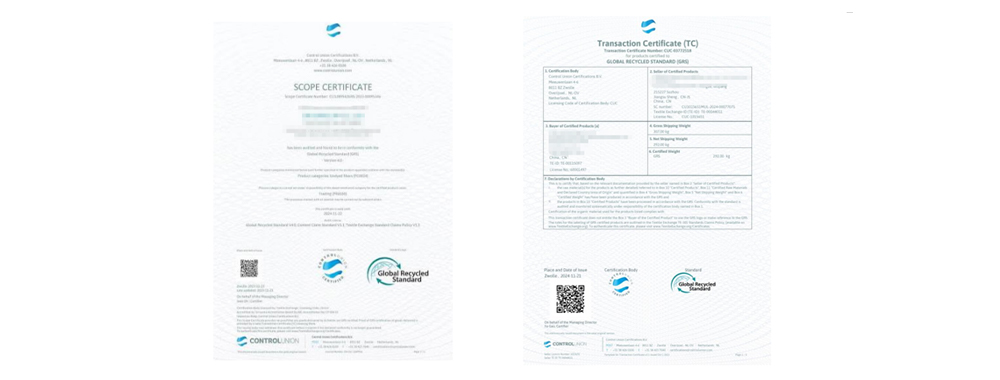
GRS certification is not a one-time audit, but a complete process covering application, auditing, certification, and ongoing monitoring.
In addition, GRS certification has a validity period. Generally, an annual surveillance audit or recertification is required to ensure continued compliance with the standard requirements. For a bag factory, planning the certification schedule in advance and coordinating preparation with upstream and downstream partners are key to successfully passing the certification process.
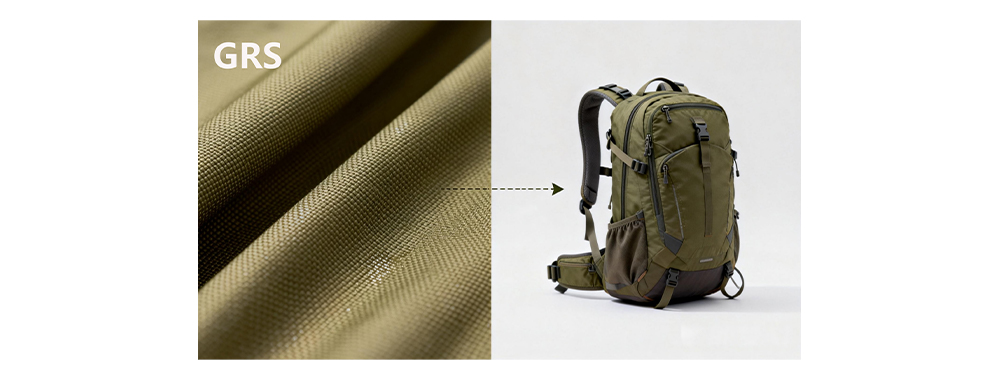
In bag manufacturing, the core role of GRS certification is to ensure that every component containing recycled materials is traceable and compliant.
When selecting recycled fibers, brands should prioritize suppliers that hold a valid GRS Scope Certificate (SC) and request the corresponding Transaction Certificate (TC) to verify the authenticity of each batch of materials.
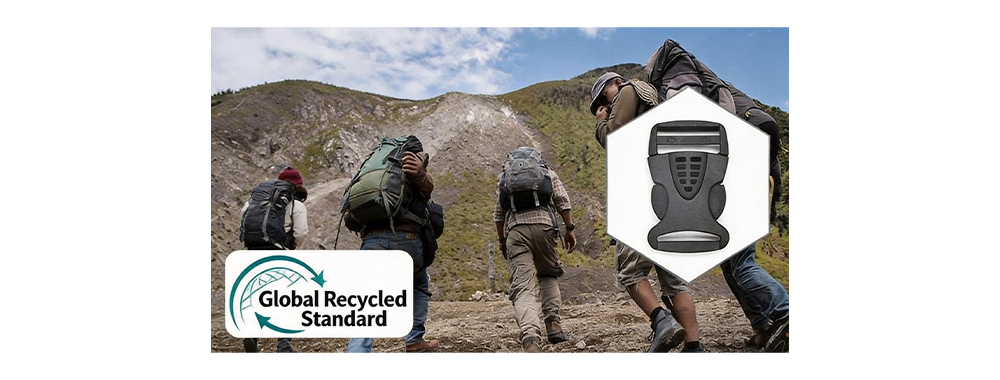
Recycled metal zippers or injection-molded buckles containing recycled plastic, if claimed to comply with the GRS standard, must also be produced by certified manufacturers. Since accessories are used in relatively small quantities but come in a wide variety of types, professional bag manufacturers typically establish strict accessory procurement records, clearly distinguishing between recycled and non-recycled accessories to prevent material mixing on the production line.
For filling materials, such as recycled cotton or recycled synthetic fiber filling, it is likewise necessary to verify their recycled content percentage and the qualifications of upstream suppliers.
Ultimately, only when all components have compliant documentation and complete, verifiable production records can the finished bags be recognized as GRS-certified products and the corresponding TC certificate be issued. Therefore, refined management throughout the entire process, from design and material selection to production and manufacturing, is the fundamental guarantee for achieving GRS compliance for bags.
The following are recommendations for brands regarding GRS fabric selection and application:
|
Material |
Supply Chain Maturity |
Suitable Bag Types |
Key Considerations for Procurement |
|
Recycled Polyester (rPET) |
High – Well-established certification system, large supply, and many certified weaving mills |
Backpacks, laptop bags, travel bags, tote bags, cooler bag linings, promotional gift bags |
Best cost-effectiveness; good colorfastness and color stability; abundant ready-stock inventory and a wide range of options |
|
Recycled Nylon (such as ECONYL®) |
Medium – Broad certification coverage |
Outdoor backpacks, travel bags, high-end functional bags, high-end handbags, sports and fitness bags |
High strength and vibrant dyeing; limited ready-stock options, with higher MOQs and unit prices; suitable for high-wear applications |
|
Recycled Cotton |
Medium – Mature system, but short fibers limit 100% recycled content |
Canvas tote bags, shopping bags, casual shoulder bags, dust bags |
Soft hand feel and a strong sustainability story; relatively lower wet strength and limited color options; often blended with rPET or virgin cotton |
|
Recycled Polypropylene (PP) |
Medium – Commonly used in woven fabric form |
Woven shopping bags, laminated tote bags, supermarket shopping bags |
Good printing performance and low cost; relatively stiff hand feel; for laminated products, compliance of the adhesive should be verified |
In addition to the mainstream materials mentioned above, companies should also pay attention to the balance between physical performance and environmental attributes when sourcing materials. For example, although recycled polyester offers good cost-effectiveness, for high-end bags, brands may prefer recycled fabrics with a special hand feel or functional properties. In such cases, the feasibility and lead time of customized development should be discussed with suppliers in advance. For recycled nylon, although it offers excellent performance, its higher cost and longer lead times require brands to become involved in supply chain planning at the early stage of product development to ensure that the project is delivered on time.
A: GRS is more comprehensive. In addition to recycled content, it also emphasizes chemicals, environmental management, and social responsibility. RCS focuses more specifically on recycled content claims. When customers only require proof of the recycled content percentage, RCS may be sufficient; when customers require stronger supply chain responsibility, GRS is generally more recognized.
A: GRS certification has clear requirements regarding recycled material content. A product must contain at least 20% recycled materials to obtain GRS certification.
The labeling claims also differ depending on the recycled content:
It should be noted that this percentage refers to the proportion by weight and only counts the certified recycled raw material portion, excluding non-fiber components such as dyes and auxiliaries. For bag brands, clearly defining this percentage helps ensure accurate marketing claims and avoid compliance risks caused by overstating environmental benefits.
A: No. The GRS standard specifically applies to “recycled” materials, meaning materials recovered and processed from post-consumer or post-industrial waste
A: Generally, yes. Certified recycled materials, dedicated batch management, documentation and TC costs, testing, and batch-to-batch variations can all increase costs. However, reasonable quotations should transparently reflect these factors. An unusually low “GRS quotation” may instead raise concerns about whether traceability and quality control have been compromised.
A: Not necessarily. It depends on whether the scope of the certificate covers the relevant materials and processes, whether the recycled content meets the requirements, whether the transaction chain is complete, and whether a Transaction Certificate can be issued for the order. The certificate establishes eligibility, while compliance for each individual batch also requires a complete documentation trail.
A: No. GRS certification follows the principle of supply chain Chain of Custody, and the final finished-product assembly factory must hold a valid GRS Scope Certificate (SC) in order to be recognized as a compliant GRS production unit. If the bag factory is not certified, even if the fabrics and accessories it uses all have compliant Transaction Certificates (TCs), the finished product cannot obtain official GRS recognition, and the brand cannot attach a GRS hangtag to the product or use the GRS mark for promotional purposes. In addition, an uncertified factory cannot issue valid Transaction Certificates to downstream customers, resulting in a break in supply chain traceability.
GRS certification is not only a “passport” for the bag industry to enter green markets, but also a core foundation for companies to build sustainable supply chain competitiveness. For backpack OEM or handbag OEM purchasers, gaining an in-depth understanding of the GRS standard means moving from passive compliance to proactive management. It requires purchasers to look beyond the price and lead time of a single finished product and extend their focus to every link of the upstream supply chain, establishing long-term partnerships based on data transparency and trust.
Please Read On, Stay Posted, Subscribe, And We Welcome You To Tell Us What You Think.




Copyright @2024 Synberry Bag & Package Products Co.,Ltd All Rights Reserved.
 Network Supported
Sitemap / Blog / Xml / Privacy Policy