Table of Contents
Ⅰ. Why Choosing the Right Leather Matters to Brand Success
Ⅱ. Understanding the Physical Properties of Genuine Leather
Ⅲ. The Brand-Matching Framework
Ⅳ. Supply Chain Risk Management
Ⅴ. How to Ensure Your OEM Factory Executes Your Leather Selection Correctly
Ⅵ. FAQ
Ⅶ. Conclusion
Ⅰ. Why Choosing the Right Leather Matters to Brand Success
For a leather goods brand, genuine leather is far more than a raw material used to make handbags. It is a core medium through which a brand establishes its identity, communicates product quality, and enhances the overall customer experience.
In practice, some emerging brands and purchasing teams fall into a common trap: selecting leather based solely on price or current trends while overlooking whether the material is truly compatible with the brand’s positioning.
This mismatch can lead to a series of downstream challenges, such as premature wear, color transfer, or deformation after a new product launches; increased customer complaints caused by inconsistent color within the same production batch; inflated costs resulting from the indiscriminate use of premium leather that cannot be reflected in the final retail price; or even damage to the brand’s reputation caused by low-quality materials.
The hand feel, structural integrity, durability, and maintenance requirements of a handbag are all heavily influenced by the choice of leather. Selecting the right material not only helps bring the original design concept to life but also creates a healthier cost structure and enables brands to manage potential after-sales risks proactively.
This guide is designed for brand product managers, sourcing teams, and product development professionals. Its goal is to establish a practical, end-to-end framework for genuine leather selection, helping decision-makers move beyond experience-based purchasing and develop a more systematic and standardized sourcing methodology.
Ⅱ. Understanding the Physical Properties of Genuine Leather
Genuine leather is made from animal hides and features a naturally developed fiber structure. Different tanning processes, hide sources, and layers of the hide result in significantly different physical properties. A thorough understanding of these fundamentals is the foundation of informed and scientific leather sourcing decisions.
2.1 Leather Classification: Full-Grain Leather and Split Leather
2.1.1 Full-Grain Leather
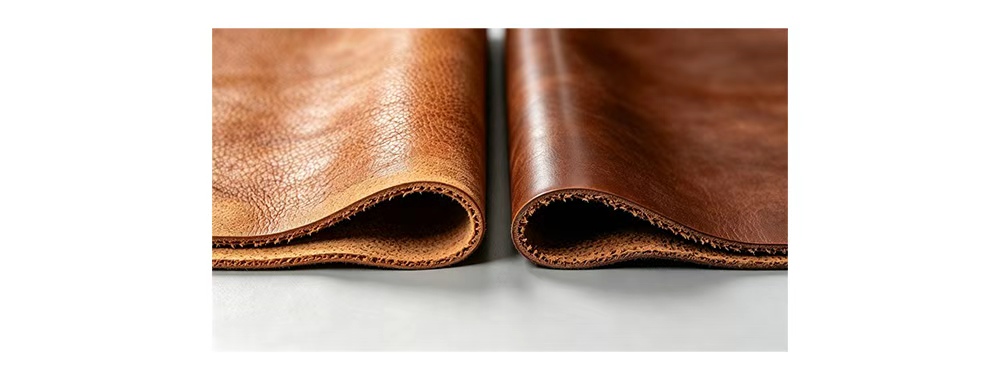
Full-grain leather comes from the outermost layer of the hide and retains the complete natural grain and tightly interwoven fiber structure.
- Advantages: It offers excellent tensile strength, superior breathability, rich natural grain characteristics, a premium appearance and feel, and outstanding durability.
- Disadvantages: High-quality hides are relatively scarce and therefore more expensive. Unless the leather undergoes significant surface correction, it may retain natural marks from the animal's life, such as scars and growth marks.
2.1.2 Split Leather
Split leather is made from the fibrous layer beneath the grain layer after the natural grain layer has been removed. Depending on the finishing process, it is mainly divided into two categories: Suede and Bicast Leather.
- Suede: Suede is produced by sanding and raising the fibers of split leather without applying a PU or PVC film coating. It has a naturally soft, napped surface and a distinctive suede-like hand feel. It is commonly used as a handbag lining and can also be used for exterior designs with a casual or vintage aesthetic.
- Bicast Leather: Bicast leather is made by applying a PU or PVC film coating to the surface of split leather to simulate the appearance of natural grain. It has a relatively uniform appearance and good abrasion resistance but offers lower breathability. It is often used for exterior surfaces of products where strict cost control is required.
- Key Characteristics: Both types of split leather generally have lower flex resistance than full-grain leather. With bicast leather in particular, repeated bending and long-term use may eventually cause the surface coating to crack or peel.
- Applications: Suede is commonly used for handbag linings or exterior designs with a casual or vintage aesthetic, while bicast leather is more commonly used as an exterior material for cost-sensitive products.
2.2 Key Physical Properties to Evaluate When Sourcing Leather
2.2.1 Tensile Strength and Structural Support
- Strength: Leather with a dense fiber structure offers strong tensile strength and good structural support, making it suitable for structured handbags.
- Softness and Structural Support: Soft leather, such as sheepskin, has a relatively loose fiber structure and limited structural support. It is more suitable for soft, slouchy, or draped handbag designs.
- Structural Stability: When selecting leather, the intended bag structure should always be considered. Soft leather may easily lose its shape when used for structured designs, while excessively firm leather may be unsuitable for soft, naturally draped styles.
2.2.2 Abrasion and Scratch Resistance
- High Abrasion Resistance: Corrected-grain leather and embossed leather, such as pebbled leather, typically have relatively substantial surface coatings and strong abrasion resistance. They are suitable for handbags intended for frequent everyday use.
- Character-Driven Materials: Waxed leather is prone to developing visible marks during use. However, minor scratches can often be blended or reduced by gently rubbing the surface with body heat. It is therefore not recommended for consumers who expect a flawless, scratch-free appearance.
2.2.3 Colorfastness
Colorfastness should be evaluated through both dry and wet crocking tests, with reference to relevant standards such as ISO 11640 or GB/T 39366.
- Warning: Dark-colored leather and washed-effect leather are more likely to present colorfastness risks. If wet-rub colorfastness does not meet the required standard, typically below Grade 3–4, depending on the applicable requirements, the leather may easily transfer color onto light-colored clothing.
2.2.4 Water Absorption and Environmental Stability
- Vegetable-Tanned Leather: Vegetable-tanned leather is susceptible to developing permanent water spots when exposed to moisture.
- Environmental Stability: Certain spray finishes may become brittle, crack, or deteriorate under extreme temperature fluctuations.
- Sourcing Recommendation: For orders intended for humid or high-temperature markets, brands should consider conducting water-resistance testing as well as high- and low-temperature testing where appropriate.
2.2.5 Tear Strength
For thin and supple leathers, such as goatskin, special attention should be paid to tear strength at high-stress areas, including strap attachment points, handle bases, and hardware openings.
Ⅲ. The Brand-Matching Framework
The most suitable leather can be identified by evaluating four key dimensions.
3.1 Brand Price Positioning
- High-End Designer Brands / Luxury Lines: Prioritize full-grain cowhide and goatskin. Preserve the natural grain and texture, minimize heavy surface coatings, and emphasize authenticity, natural beauty, and material scarcity.
- Mid-Range Sustainable Luxury Brands: Consider environmentally responsible top-grain leather, such as vegetable-tanned leather, to balance premium quality with scalable supply while strengthening the brand’s sustainability narrative.
- Mass-Market Fashion Leather Goods: High-quality film-coated split leather can be selectively used to control costs while maintaining a consistent appearance.
3.2 Target Consumer and Usage Scenario
- Business and Commuting Consumers Who Prioritize Durability: Embossed cowhide, such as pebbled or cross-grain leather, and corrected-grain cowhide are recommended. Their stable surface coatings provide strong scratch resistance and require relatively little maintenance.
- Character-Driven Materials: Waxed leather tends to show marks easily and is better suited to consumers who appreciate the natural character of leather.
- Younger, Fashion-Conscious Consumers Who Prioritize Aesthetics: Soft, supple leathers with rich color options are often a better fit. Nappa leather and lightly tumbled leather can create a naturally relaxed and contemporary appearance.
- Outdoor and Vintage-Style Enthusiasts: Vegetable-tanned leather is an excellent choice. Its color gradually deepens and develops a unique patina with use, allowing each product to acquire distinctive signs of aging over time.
3.3 Product Structure
- Structured Bags Such as Briefcases and Totes: These require firm cowhide with a dense fiber structure and high tensile strength, such as vegetable-tanned leather, sometimes referred to as firm tooling leather.
- Soft Cloud Bags and Shoulder Bags: These are better suited to leathers with a relatively loose fiber structure and a soft, supple hand feel, such as sheepskin or soft Nappa leather.
- Core Principle: The construction of a handbag directly limits the range of leather that can be used. Soft leather cannot naturally support a rigid silhouette without additional reinforcement, while overly firm leather is unlikely to produce soft, natural folds and draping.
3.4 Brand Core Value Proposition
- Brands Built Around Sustainability and Natural Materials: Avoid heavily finished or heavily coated leather whenever possible. Prioritize drum-dyed, aniline, semi-aniline, or lightly finished vegetable-tanned leather, as well as leather sourced from tanneries with recognized environmental certifications such as LWG certification.
- Brands Focused on Minimalist Durability: Prioritize structurally stable, high-performance full-grain cowhide and reduce the use of delicate materials that may lead to avoidable after-sales complaints.
- Practical Recommendation: Build an internal leather database for your brand. Before developing each new product, evaluate and score candidate leathers against the four dimensions above. This approach can significantly reduce unnecessary sampling and development costs.
Ⅳ. Supply Chain Risk Management
Unlike synthetic leather, which can be manufactured with highly consistent industrial processes, genuine leather is made from animal hides and naturally varies from one piece to another.
This inherent variability is one of the most significant—and frequently overlooked—sources of risk in leather sourcing.
4.1 Two Major Natural Challenges and How to Manage Them
4.1.1 Batch-to-Batch and Texture Variation:
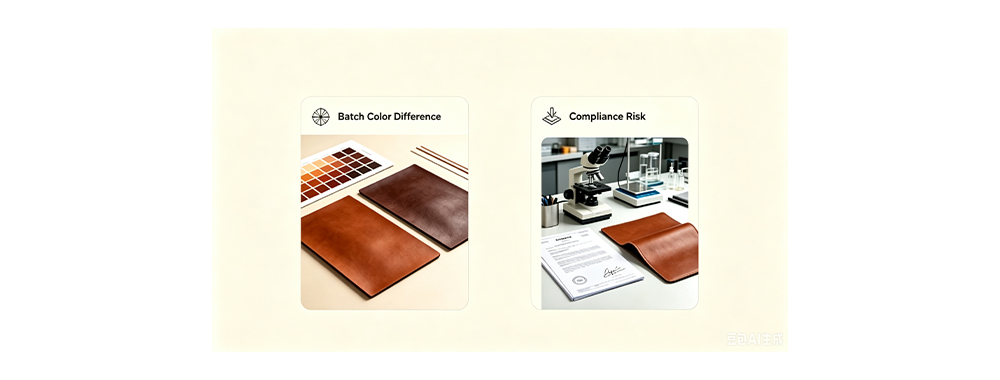
The Consistency Risk: Every hide is unique due to factors such as the animal’s living environment, climate, season, and natural growth patterns. Even when the same factory produces the same leather article, 100% replication from one production batch to another is impossible.
Recommended Solution: Establish a strict limit sample system before mass production. Approve and seal a reference sample that clearly defines acceptable ranges for color variation, grain differences, natural marks, and other visual characteristics.
Additional Recommendation: Reserve a certain quantity of additional leather during bulk production to allow for selective cutting and quality control.
4.1.2 Environmental and Regulatory Compliance Risks:
Environmental and regulatory requirements for leather goods continue to become more stringent worldwide. Key areas of concern include heavy metals, restricted azo dyes, volatile organic compounds (VOCs), and animal-origin traceability requirements.
Recommended Approach: For products intended for European and U.S. markets, leather compliance should be verified before placing production orders. Materials must meet applicable regulatory requirements, including the relevant provisions of the EU REACH framework where applicable.
4.2 Practical Recommendations for Brands
- Core Leather Materials: Select mature, proven leather types with stable production capacity to protect lead times and ensure consistent quality.
- Specialty or Niche Materials: Brands should be prepared to accept a certain degree of natural imperfection. These characteristics should be clearly communicated to customers before purchase so that expectations are properly managed.
- Retained Samples: Keep retained samples from every bulk production batch of leather.
- Traceability: In the event of a quality dispute, retained samples provide critical evidence for traceability and serve as an important safeguard for protecting the brand’s reputation.
Ⅴ. How to Ensure Your OEM Factory Executes Your Leather Selection Correctly
Once the leather direction has been determined, the OEM factory will take responsibility for sampling, process optimization, and mass production.
Whether the selected leather can be successfully translated into the final product depends largely on whether the brand takes four key steps at the beginning of the development process.
5.1 Involve the OEM Factory in the Evaluation Process Early
At the early sampling stage, ask the OEM factory to evaluate the selected leather from three perspectives:
- Manufacturing Complexity: Evaluate whether the selected leather is suitable for the required construction and manufacturing techniques.
- Material Yield and Cutting Loss: Assess how much usable material can be obtained from each hide and how natural defects may affect cutting efficiency.
- Special Processing Requirements: Identify whether the leather requires specific cutting, skiving, edge-painting, stitching, or finishing processes.
- Key Benefit: Early evaluation helps identify potential issues before production begins, reduce implementation risks, and minimize costly modifications later in the development cycle.
5.2 Translate Quality Requirements into Quantifiable Standards
Avoid relying solely on descriptions such as “soft hand feel” or “color close to the reference sample.”
Whenever possible, provide measurable specifications, including:
- Acceptable Thickness Tolerance
- Permissible Color Difference
- Maximum Size of Allowable Defects
- Acceptable Defect Frequency and Distribution
- Supply Chain Alignment: The OEM factory should communicate these requirements directly to the leather supplier to ensure consistency throughout the supply chain.
5.3 Leverage the Factory’s Supply Chain Resources
Established OEM manufacturers often maintain long-term relationships with major tanneries and leather suppliers.
- Competitive Pricing: They can help brands negotiate more competitive pricing.
- Production Capacity: They can help secure production capacity and prioritize material allocation.
- Material Testing: They can coordinate leather testing and manage batch-level quality control.
- Risk Reduction: This can significantly reduce the communication burden and quality risks associated with brands working directly with upstream suppliers.
5.4 Allow Sufficient Development Time and Avoid Compressing the Timeline
- Development Process: The development process should progress gradually from the initial prototype and confirmation sample to the pre-production sample and finally to mass production.
- Testing and Adjustment: Adequate time should be reserved for leather testing, process adjustments, and production validation.
- Risk Control: Allowing sufficient development time is one of the most effective ways to reduce mass-production risks.
Ⅵ. FAQ
We have summarized seven of the most common questions brands ask when sourcing genuine leather to help you make more informed decisions.
Q1: Does Natural Leather with Scars or Uneven Grain Mean It Is Poor Quality?
A: Not necessarily. These are natural characteristics of genuine leather rather than defects.
- The Objective Reality: High-quality full-grain leather cannot be perfectly flawless in the same way as synthetic leather. Natural marks such as neck wrinkles and growth marks are normal characteristics of premium full-grain leather and can actually serve as evidence of its authenticity.
- Quality Assessment: A natural mark should generally only be considered unacceptable when it is concentrated in a highly visible area of the handbag and materially affects the overall appearance.
- Our Recommendation: Before production, brands should establish a clearly approved limit sample with the factory, defining acceptable locations, sizes, and types of natural marks. This helps prevent disputes during bulk production.
Q2: Is Vegetable-Tanned Leather Suitable for Large-Scale Production of Fashion Handbags?
A: It requires careful consideration and is generally better suited to niche, vintage-inspired product lines.
- Advantages: It offers an unmistakable natural appearance, distinctive character, and an authentic patina that cannot easily be replicated by other leather types.
- Disadvantages: Its physical properties are more sensitive to environmental conditions. It can develop water marks, change color with prolonged exposure to light, require more controlled processing conditions, and show unavoidable batch-to-batch color variation.
- Recommended Applications: It is particularly suitable for niche vintage collections and products emphasizing craftsmanship and a handmade aesthetic.
- Production Consideration: For fast-moving fashion products that require high-volume production and extremely consistent appearance, brands should use vegetable-tanned leather with caution or consider semi-vegetable-tanned or chrome-tanned alternatives.
Q3: What Tests Are Required When Sourcing Leather for Orders Exported to Europe and the United States?
A: Regulatory compliance is the baseline requirement for entering international markets.
- Basic Testing Typically Includes: Azo dyes, heavy metal content, formaldehyde, and VOCs (volatile organic compounds).
- Additional Requirements: Some countries and brands may require documentation proving the traceability and country of origin of the animal hides.
- Best Practice: Brands should consider requesting relevant compliance documentation from leather suppliers, including evidence of LWG-certified upstream tanneries where applicable, as well as test reports demonstrating compliance with relevant EU REACH requirements.
- Business Value: These documents can serve as important credentials when entering premium European and U.S. markets.
Q4: How Can You Verify Whether a Supplier’s “Full-Grain Leather” Is Genuine?
A: Examine the cross-section and perform a pressure test.
- The Pressure Test: Press the leather surface gently with your finger. Genuine full-grain leather typically develops fine, natural wrinkles radiating outward from the point of pressure and returns relatively quickly to its original appearance when released.
- Visual Inspection: Examine the cross-section of the leather. Genuine full-grain leather generally shows a dense and naturally structured fiber pattern.
- The Most Reliable Method: Before entering into formal cooperation, request a third-party material testing report whenever necessary. Objective test data is the most reliable way to verify material claims.
Q5: Is Full-Grain Leather Always Better Than Split Leather?
A: No. The two materials simply come from different layers of the hide and are suited to different brand and product requirements.
- Full-Grain Leather: Full-grain leather retains the natural grain layer and generally offers better breathability and a more authentic grain appearance. It is commonly used in mid- to high-end products.
- Split Leather: Split leather is produced after the hide is split and may be further finished with surface coatings. It offers lower material costs, fewer visible surface imperfections, and higher material utilization, making it suitable for more price-sensitive, high-volume products that require a consistent appearance.
- Core Principle: There is no absolute hierarchy of “better” or “worse.” The right leather is the one that best matches the brand’s positioning and the product’s intended use.
Q6: Is Nappa Leather Genuine Leather? What Price Tier Does It Belong To?
A: Nappa leather refers primarily to a processing style and a characteristic hand feel, rather than a specific leather grade.
The defining characteristics of Nappa leather are exceptional softness, a smooth and refined surface, and a relatively light finish.
- Full-Grain Nappa Leather: The highest-end category, retaining the natural grain and pores of the hide.
- Corrected-Grain or Top-Grain Nappa Leather: A mainstream category that undergoes light surface correction and finishing.
- Split Leather or Synthetic Materials Marketed as “Nappa Grain”: Some suppliers may use the term “Nappa” or “Nappa-style” to describe PU-coated split leather or microfiber materials.
- Key Takeaway: The word “Nappa” alone should not be treated as proof of leather quality or authenticity.
Q7: How Do Different Leather Types Compare in Terms of Maintenance Difficulty and After-Sales Risk?
A: From a manufacturing and after-sales risk perspective, leather types can generally be ranked from lower to higher risk as follows:
- Corrected-Grain Chrome-Tanned Cowhide / Coated Leather: These materials typically have more substantial surface coatings and offer good water and stain resistance, making them relatively easy to maintain and associated with the lowest after-sales risk.
- Full-Grain Chrome-Tanned Cowhide: It retains a degree of natural resistance to everyday use, and minor scratches may blend into the surface over time.
- Nappa Leather: Its lighter finish provides a soft and luxurious feel but makes the surface more susceptible to visible fingernail marks and scratches. Customers should be advised to avoid contact with sharp objects.
- Tumbled Leather: Its textured grain can help disguise minor imperfections, but some varieties may absorb moisture easily and develop water marks.
- Vegetable-Tanned Leather: This is one of the most delicate options. It can darken or change color when exposed to water, absorb oils, and develop scratches easily.Customers should be clearly informed that these characteristics are inherent to vegetable-tanned leather and should not automatically be considered quality defects.Setting expectations in advance can significantly reduce after-sales disputes.
Ⅶ. Conclusion
The unique appeal of a genuine leather handbag comes from the irreplaceable character and texture of natural leather.
The true art of sourcing is not about blindly pursuing the most expensive or the least expensive material. It is about identifying the material that achieves the right balance between brand positioning, design aesthetics, product performance, and cost structure.
Leather selection should not be a subjective guessing game. It should be a standardized and systematic decision-making process.
By establishing a rigorous evaluation framework, conducting appropriate material testing, and implementing effective risk controls, brands can ensure that leather, design, and manufacturing processes work together seamlessly.
Respecting the natural characteristics of genuine leather and planning the sourcing process rationally are not only fundamental to creating successful products—they are also essential to building a sustainable, long-term leather goods brand.
As a supply chain partner with 30 years of experience specializing in genuine leather handbag OEM manufacturing, SYNBERRY provides end-to-end support covering leather selection, material performance testing, sample development, and large-scale production.
We help brands connect every stage of the process—from material selection to finished-product delivery—so that high-quality leather can be successfully transformed into commercially viable, production-ready products.





 Network Supported