How to Create the Perfect Custom Logo for Your Bags
Nov 12, 2025
In custom bag design, the logo is not just a decoration, it is the core element of a brand’s identity. A well-fit logo not only enhances the product's visual recognition but also conveys the brand's values.
As the manufacturing processes continue to evolve, the ways to implement a custom bag logo have become increasingly diverse. This article will ultimately analyze the main types of custom bag logo techniques, from conventional methods to innovative technologies, helping brands choose the most relevant solution.
Part 1: Logo customized options for oxford fabric bags such as nylon backpacks, polyester duffel bags, travel bags, school bags, crossbody bags and so on.
1. Silk Screen Printing
Silk screen printing is one of the most classic and widely used logo production techniques. It works by transferring ink through a mesh screen template onto the surface of the fabric, creating patterns or text. Known for its vibrant colors and stable craftsmanship, it is one of the most frequently used printing methods in bag branding.
1) Basic Process
• Screen Preparation: Create a screen plate based on the logo design, with each color requiring a separate screen.
• Coloring: Evenly scrape the ink onto the fabric surface, allowing the ink to pass through the mesh to form the design.
• Drying and Curing: Air dry the fabric to ensure the ink adheres firmly to the material.
• Post-treatment: Check the print for completeness and color uniformity, making necessary repairs or adding a transparent gloss coat to protect the ink.
2) Advantages
• Vibrant Colors and Strong Coverage: It achieves bold visual effects, with the logo clearly visible even from a distance.
• Durability: The ink, once dried, adheres strongly to the fabric and is resistant to fading or peeling.
• Applicability: Suitable for various flat or slightly curved materials.
• Cost-Effective: It offers a high cost-performance ratio when producing large quantities, especially if the logo is solid or few colors only.
3) Disadvantages
• Not Suitable for Complex Multi-color Designs: Each color requires a separate screen, which makes printing process pretty time consuming and costly.
• Limited Detail Performance: Not ideal for high-precision designs, gradient colors, or photographic images.
• Surface Smoothness Requirement: If the fabric texture is too rough or has strong contours, it may lead to uneven ink application or misprints.
4) Most Suitable Bag Materials and Applications
Silk screen printing is especially suitable for materials with relatively smooth surfaces, such as nylon, polyester, cotton, canvas fabrics.
• Nylon and Polyester Bags: Such as sports backpacks, travel bags, and student backpacks, where the print is clear, durable, and washable.
• Canvas and Cotton Bags: Such as eco-friendly bags, shopping bags, and tote bags.
Silk screen printing is not recommended for use on genuine leather, PU leather, or fabrics with strong textures, as the ink may not adhere well, leading to fading or blurring.
2. Heat Transfer Printing
Heat transfer printing is a process that uses high temperature and pressure to transfer a design from a transfer film onto the fabric surface. It is known for its fine detail and rich colors, making it ideal for bags that require complex patterns or multi-color logos. Compared to silk screen printing, heat transfer printing can better reproduce visual effects like gradients and shadows, making it one of the most popular techniques in bag productions.
1) Basic Process
• Print the Design: First, the logo design is printed onto a special transfer film (or transfer paper).
• Positioning: The printed transfer film is carefully placed onto the fabric of the bag.
• Heating and Pressing: Using a heat press machine, the ink is transferred onto the fabric at high temperatures (about 140°C to 180°C) and high pressure.
• Peel Off the Film: After cooling, the film layer is peeled off, leaving the design firmly attached to the fabric.
2) Advantages
• Fine Details and Strong Color Performance: It can achieve effects like gradients, shadows, and photo-quality images.
• Suitable for Complex Designs: Multi-color logos can be completed in one step without repeated processes.
• Smooth Surface and Soft Feel: The surface is smooth with no heavy feel, ideal for close-fitting or lightweight bags.
• Flexible for Small-Batch Production: No screen plate is needed, making it suitable for sample development or small batch production.
3) Disadvantages
• Limited Heat Resistance: If applied to fabrics that melt easily or deform under heat, the surface of fabric may be damaged.
• Less Durability than Silk Screen Printing: Long-term friction may cause peeling or fading at the logo edges.
• Higher Cost: The cost is higher than silk screen printing, especially for large size logos.
4) Suitable Bag Materials and Applications
Heat transfer printing is ideal for materials that have moderate heat resistance and a smooth surface, such as nylon, polyester, T/C cotton, not suitable for plastic materials such as TPU, or PU-coated fabrics.
• Cotton or Canvas Tote Bags: Vibrant colors and rich logo details create a strong visual impact.
• Children's Backpacks: Large fabric areas can be printed with colorful patterns, creating a dynamic visual effect.
• Recycled Fabrics and Eco-Friendly Products: The heat transfer process is clean and environmentally friendly, with no solvent residues, aligning well with sustainability principles.
Heat transfer printing is not recommended for use on genuine leather or linen-cotton canvas, as natural fibers absorb heat unevenly, which can cause the edges of the design to lift or lead to color discrepancies.
3. Embroidery Logo Technique
Embroidery is a logo customized method that offers a tactile, layered feel. It involves stitching patterns onto fabric using needles and threads, reflecting the brand’s fine craftsmanship while adding a handmade touch and a sense of luxury to the bag.
Aside from a few high-end custom bags that might retain hand embroidery, today most embroidery logos on bags are completed through Digital Embroidery and Computerized Embroidery. These techniques involve importing design files (e.g., DST, EMB formats) into automatic embroidery machines, achieving precise and efficient stitching, ensuring consistent stitch density, direction, and color, greatly enhancing production efficiency and product stability. Almost all types of embroidery techniques (such as flat embroidery, 3D embroidery, and appliqué) can be executed by computerized embroidery machines, making them widely adopted in mid-to-high-end custom bag manufacturing.
Digital Embroidery
Digital embroidery uses digital image files to control the embroidery machine, allowing for high precision and consistency, especially suitable for complex logos and multi-color designs.
Computerized Embroidery
The most common embroidery technique used in bag manufacturing. It uses programmed paths for stitching and color switching, enabling mass production with high fidelity in design output.
Hereunder, we display full types of embroidery logos and their related applications.
• Plain Embroidery
This uses even and flat stitches to present the design, ideal for simple brand text or small logos.
Common Applications: Oxford fabric bags.
• 3D Foam Embroidery
Foam is added beneath the stitches, making the embroidered area rise, adding dimensionality and texture.
Common Applications: Baseball caps, sports bags, trendy backpacks.
• Hollow 3D Embroidery
Combines a 3D structure with a hollow effect, maintaining lightness while enhancing the spatial sense.
Common Applications: Functional backpacks, bags with a bold personalized look.
• Appliqué Embroidery
Embroidered fabric pieces are sewn onto the main materials, enhancing visual impact.
Common Applications: Limited edition collaborations, retro-style designs.
• Loop/Terry Embroidery
Uses looped threads to create a soft, velvety texture, providing a 3D and warm feel.
Common Applications: Children's bags, fall/winter bags like puffy bags.
• Brush Embroidery
Similar to loop embroidery, but with shorter, denser threads, it create a extremely tidy surface while short-haired brush from the side look.
Common Applications: sports-enthusiasm bags.
• Cord/Tape Embroidery
Uses ribbon-like threads to form designs, resulting in smooth, metallic-looking lines.
Common Applications: High-end brand logos, elegant handbags, evening bags.
• Ribbon Embroidery
Uses ribbons instead of threads to create 3D flower or ribbon effects.
Common Applications: Women’s bags, fashion-forward designs with a strong craft taste.
• Sequin Embroidery
Sequins are sewn onto the fabrics, creating a sparkling, glossy effect.
Common Applications: Evening bags, children’s bags, festive designs.
• Bead Embroidery
Beads or metal particles are added to the embroidery, providing a luxurious and intricate texture.
Common Applications: Gift bags, Velvet pouches/cases
• Drawn-thread Embroidery
Certain threads are removed and re-woven to create a fine, breathable texture.
Common Applications: Linen bags, natural-style collections.
• Eyelet/Cut-out Embroidery
Holes are punched and bordered to form a lacy, open pattern, creating a light, airy look.
Common Applications: Summer bags, gypsy-style designs.
Summary: The charm of embroidered logos lies in their 3D texture, durability, and high recognition value. Different types of embroidery techniques can be flexibly combined with various fabrics, offering unique styles from casual to high-end collections.
4. Hot Stamping / Emboss / Deboss
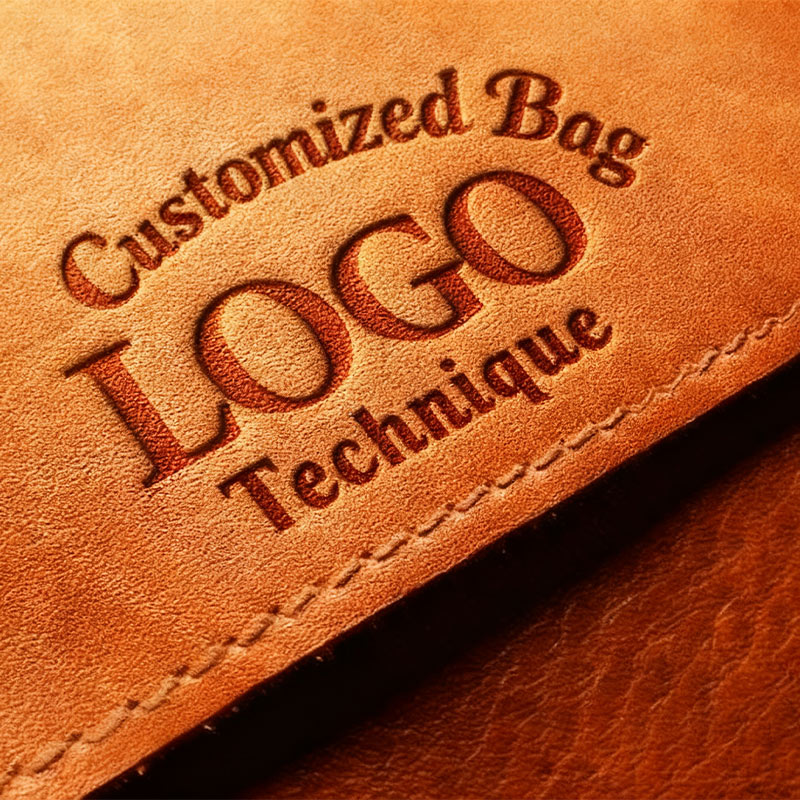
Hot stamping and embossing are two logo techniques that conveys “texture" and craftsmanship onto bags. Rather than relying on color, these methods use heat and pressure to create raised or recessed effects on leather or leather-like materials, producing a subtle yet lasting brand mark.
1) Process Principles
• Hot Stamping: This technique uses a heated metal tooling to press the logo onto the fabric surface at high temperature and pressure. Depending on whether foil is used, it can be divided into hot stamping (with color or metallic foil) and hot pressing (without foil, leaving only an imprint).
• Embossing / Debossing: These methods use two molds (upper and lower) to apply pressure, creating either a raised (embossed) or recessed (debossed) effect on the material surface.
2) Main Process Steps
• Create the Mold: A copper or brass mold is customized based on the logo design.
• Position and Align: The mold is fixed onto the hot press machine and aligned with the bag’s logo area.
• Heat and Apply Pressure: The mold is pressed onto the material at a set temperature (usually 100-150°C) for a few seconds, imprinting the logo texture onto the material's surface.
• Cooling and Setting: After cooling, a permanent impression or hot stamp effect is formed.
3) Advantages of the Process
• High-end Texture and Strong Recognition: The logo naturally blends with the leather surface, offering a subtle yet powerful aesthetic.
• Excellent Durability: The logo will not fade, peel, or delaminate, maintaining a lasting brand mark.
• Tactile Experience: Raised or recessed logos offer a rich, dimensional feel.
• Ideal for High-end Products: Commonly used in business bags, briefcases, luxury handbags and more.
4) Disadvantage
• Only Suitable for Specific Materials: The material must be thick and pliable, such as genuine leather or PU leather.
• Not Suitable for Complex Designs or Small Text: Excessive detail may cause the design to blur due to uneven pressure distribution.
• Limited Color Variations: Hot stamping and embossing primarily focus on the three-dimensional effect, with limited color representation.
• Mold Costs: Each logo requires a custom mold, making small-batch production relatively costly.
5) Most Suitable Bag Materials and Applications
Hot stamping and embossing are most commonly used on materials like genuine leather, PU leather, vegetable-tanned leather, and synthetic leather, which can form stable textures under heat and pressure without damaging the surface structure.
• Business and High-end Bag Collections: Such as leather briefcases, folders, and business card holders, where the logo effect is simple and refined.
• Brand Handbags and Wallets: Gold or silver hot stamped logos can enhance the luxurious feel, while debossed logos offer a more subtle elegance.
Important Reminder: This process is not suitable for fabrics such as nylon, canvas, or polyester, as these materials lack the necessary support to form clear impressions, and high temperatures may cause the material to melt or damage.
5. Rubber / Silicone / soft PVC / Epoxy Labels
Rubber, silicone, and epoxy labels are soft, three-dimensional, and colorful logo techniques made from soft plastic materials. These logos highlight the brand's playfulness and visual impact while offering water resistance, abrasion resistance, and safety features.
1) Production Process
• Design and Molding: Create a mold based on the logo shape, which can be made from rubber, soft PVC, or silicone materials.
• Injection Molding: Inject different colored soft rubber materials into the mold to form a multi-layered three-dimensional logo.
• Epoxy Treatment (Optional): Apply a transparent epoxy or gel layer to the logo surface to make it smooth and shiny, adding more dimension (mainly for silicone/epoxy labels).
• Cutting and Back Treatment: Cut the logo to the desired size and apply backing adhesive, sewing lines, or heat-press it onto the bag surface.
2) Advantages
Vibrant Colors and Strong Three-dimensional Effect: Achieve multi-color combinations and embossed effects with noticeable visual impact.
• Soft and Safe: The material is flexible, non-abrasive, and comfortable to the touch.
• Waterproof and Wear-resistant: Suitable for outdoor or sports bags, maintaining clarity and visibility even after prolonged use.
• Flexible Production: Can be customized in small batches, perfect for limited edition or personalized designs at affordable cost.
• Versatile Application: Can be applied to the surface, straps, or accessories of bags with high design flexibility.
3) Disadvantage
• Casual and Sporty Style: Not suitable for high-end luxury or business bags, as the visual style tends to be more youthful and casual.
• Limited Detail Rendering: Fine lines or complex gradient patterns may not be accurately represented.
• Limited High-Temperature Resistance: High temperatures may affect the transparency or flexibility of the epoxy layer (silicone/epoxy labels).
• The logo surface get dust easily: Matte rubber or soft epoxy labels can attract dust and require regular cleaning.
4) Suitable Fabrics and Applications
Rubber, silicone, and epoxy labels are basically suitable for all materials of bags, whether they are nylon, polyester, canvas, or leathers.
Common application scenarios include
• Sports Bags, Outdoor Backpacks, Hiking Bags: Waterproof and wear-resistant, with a three-dimensional logo emphasizing the brand's sporty style.
• Travel Bags, Functional Bags: Bright colors, easily identifiable logos, and durability.
• Accessory Products: Such as shoe bags, hat bags, and waist bags, enhancing visual recognition and decorative effect.
5) Extension Suggestions
• If you want a crystal-clear and shiny logo, consider silicone/epoxy labels.
• If durability, waterproofing, and color saturation are priorities, opt for rubber/PVC labels.
• A combination of both can be used, for example: using a rubber label as the main logo with epoxy covering for added gloss and tactile appeal.
6. Metal Logo / Metal Nameplate
Metal logos and electroplated nameplates are the logo techniques that best convey a sense of luxury and brand prestige in bags. Both are based on metal materials, with logos created through engraving, stamping, embossing, or similar methods, followed by surface treatments to achieve different styles. While the basic process is similar, they differ slightly in terms of visual effect and application focus:
Metal Logo: Can be made with 3D embossing, raised impressions, or recessed designs. The color can be achieved through spray painting, filling, or electroplating. It is more decorative and three-dimensional, suitable for small logos, hardware accessories, or details on the bag.
Electroplated Nameplate: Typically made from metal sheets that are fully electroplated (with finishes such as bright gold, silver, gunmetal, etc.), offering a uniform glossy surface. This style is more refined and elegant, often used for main brand logos or nameplate identification.
1) Production Process
• Design and Mold Creation: A custom metal mold is made based on the logo shape, size, and thickness.
• Forming Process: The logo's outline is created through stamping, embossing, or etching.
• Surface Treatment: The metal logo is finished with processes such as electroplating, sandblasting, polishing, brushing, or enamel filling to achieve the desired texture and color.
• Fixing and Installation: The metal logo or nameplate is fixed to the bag surface using rivets, screws, or strong adhesives.
2) Advantages
• High-end Texture: The metallic shine and three-dimensional effect highlight the brand’s premium quality.
• Durability: Metal logos are resistant to wear, high temperatures, and maintain clear identification over time.
• Versatile Design: They can achieve various colors, textures, and raised/recessed effects, catering to diverse brand styles.
• Enhanced Brand Recognition: Particularly suitable for business bags, high-end handbags, limited edition items, and flagship brand collections.
3) Disadvantage
• Higher Cost: Molding, production, and assembling costs are higher than woven labels, rubber tags, or embroidery.
• Added Weight: Compared to lightweight logos, metal logos or nameplates can slightly increase the weight of the bag.
• Assemble Requirements: Improper installation can damage the fabric or cause the logo to loosen.
Not Suitable for Soft, Thin Fabrics: For lightweight materials such as thin nylon or cotton, additional reinforcement is required for secure installation.
4) Suitable Fabrics and Application Scenarios
Metal logos and electroplated nameplates are best suited for materials such as genuine leather, PU leather, synthetic leather, thick laminated nylon fabric, and heavy sturdy canvas.
Common applications include
• Business Briefcases and Laptop Bags: Enhancing a professional and sophisticated feel.
• High-end Handbags and Limited Edition Bags: Uniform style with hardware accessories, boosting the luxurious feel.
• Luggage / Travel Bags: Metal logos are durable and impact-resistant, keeping the logo clear over time.
• Gift Bags and Brand Collaborations: Custom metal nameplates increase collectible and display value.
If the fabric is thin or soft, consider using a metal tag or metal puller to present the logo. This retains the metal feel while preserving the bag's structure.
7. Leather Patch / PU Patch
Leather patches are one of the most sophisticated and stylish ways to express a logo on bags. Made from genuine leather or synthetic leathers (such as PU, microfiber leather, etc.), leather patches combine brand logos with the texture of leather through processes such as hot stamping, embossing, laser engraving, and stitching, creating a natural and high-end visual effect.
1) Production Process
• Material Selection and Cutting: Choose the appropriate leather material (top-grain leather, split leather, PU, vegetable-tanned leather, etc.) based on the design style, and cut it into the required shape.
• Logo Creation: The logo is applied using techniques such as hot stamping, embossing, laser engraving, silk-screen printing, or metal patches according to customer specifications.
• Coloring and Edge Sealing: Some leather patches are dyed and finished with oil to smooth the edges and enhance the color richness.
• Stitching or Rivet Fixing: Leather patches are typically attached to the bag surface using stitching, rivets, or heat-sealed adhesive.
2) Advantages
• High-End Texture: The natural grain and sheen of leather give the bag a strong brand character.
• Multiple Techniques Available: Can combine hot stamping, laser engraving, metal inlays, and other logo techniques for unique expressions.
• Durability: High-quality leather ensures that the logo remains clear and resistant to fading after embossing or hot stamping.
• Enhances Overall Quality: Whether as a small decorative element or a large brand display, leather patches significantly elevate the product’s appeal.
3) Disadvantage
• Not Washable: Genuine leather or some PU leathers may deform when exposed to water, making it unsuitable for bags that need frequent washing.
• Temperature Sensitive: High temperatures can cause discoloration or hardening of the leather.
• Higher Cost: Genuine leather, in particular, is more expensive and is primarily used in mid- to high-end bags.
• Not Suitable for Too-Soft Fabrics: Leather patches are relatively thick and may affect the feel or cause local deformation if applied to lightweight fabrics.
4) Suitable Bag Materials and Applications
Leather patches are compatible with a variety of fabrics but are best suited for thicker and supportive materials like canvas, cotton-linen blends, Oxford cloth, and leather.
Common applications include:
• Casual Canvas Bags / Collegiate Style Backpacks: Leather patches create a natural contrast with fabric, highlighting a rustic, earthy aesthetic.
• Business Briefcases / Laptop Bags: Leather logos enhance the overall style, reinforcing brand recognition.
• Genuine Leather Bags / PU Fashion Bags: Leather patches can match the color of the main leather or contrast with it, showcasing craftsmanship in details.
• Travel Bags / Workwear-style Bags: Combined with heavy fabrics or waxed canvas, leather patches evoke a vintage and durable feel.
5) Extension Suggestions
If you want to balance visual depth with environmental concerns, consider using vegan PU leather patches or recycled leather patches, which offer a high-end appearance along with a sustainable concept.
Additionally, leather patches can be combined with metal plates, woven labels, or rubber tags to create a unique mixed-style, enhancing the brand recognition and design appeal of the bag.
8. Woven Label / Fabric Label
Woven labels or fabric labels are among the most classic and common forms of logo representation on bags. These labels are created by weaving yarn into text, patterns, or graphic logos. They are soft, delicate, and finely crafted, serving not only as brand identification elements but also as part of the decorative design.
1) Production Process
• Logo Design and Layout: Based on the font, line thickness, and the number of colors, the appropriate weaving method (plain weave, satin weave, jacquard, etc.) is determined.
• Weaving Process: Using a computerized jacquard loom or high-speed weaving machine, different colored yarns are interwoven to form the logo design.
• Shaping and Cutting: After high-temperature shaping, the label is cut to the required size, and various edge treatments (heat-cut edges, border stitching, folded edges) can be applied.
• Post-processing and Sewing: The label can be attached with backing adhesive or sewn onto the exterior, lining, shoulder straps, or interior tag areas of the bag.
This technique emphasizes precision in lines and color layers, achieving a delicate brand representation effect.
2) Advantages
• Exquisite and Durable: Since the logo is directly woven from yarn, it is resistant to fading, cracking, or peeling, making it suitable for long-term use.
• Highly Adaptable: It can be sewn flexibly onto the bag's exterior, lining, or shoulder straps, making it suitable for a variety of design styles.
• Soft to the Touch: It will not irritate the skin or affect the comfort of use, especially suitable for close-fitting or lightweight products.
• Multiple Display Options: Available in matte, glossy, jacquard, satin, and other weaving methods, allowing for customization to match different brand aesthetics.
• Cost-Effective: With low production costs and short lead times, woven labels are a commonly used and mature logo solution.
3) Disadvantage
• Limited Layering: Only 2D designs can be represented; not suitable for three-dimensional or metallic textures.
• Color Limitations: If the logo contains too many colors or gradient effects, it may be difficult to reproduce accurately.
• Not Waterproof or Stain-Resistant: Exposure to humid or dirty environments may affect the colors.
• Lightweight Texture: For bags that emphasize high-end or structured styles, the visual impact of woven labels may seem insufficient.
4) Suitable Bag Materials and Application Scenarios
Woven labels or fabric labels are compatible with almost all bag materials, especially nylon, polyester, canvas, cotton-linen blends, and Oxford cloth.
Common applications include:
• Backpacks and Casual Bags: Often used for exterior brand labels, shoulder straps, pocket edges, etc., offering a clean and attractive look.
• Laptop Bags / Briefcases: Black and white or low-saturation woven labels convey a professional and stable vibe.
• Travel Bags / Sports Bags: Paired with rubber labels or heat transfer logos for added visual depth.
• Interior Labels and Brand Tags: Used to display the brand name, product information, or manufacturing origin, combining functionality and decoration.
5) Extension Suggestions
To add more three-dimensional or tactile effects to woven labels, consider the following variants:
• High-Density Woven Labels: Higher yarn density and more refined patterns, commonly used by high-end brands.
• Woven Badge: Thickened backing and edge stitching to enhance texture and support.
• Fabric Label + Leather Patch Combination: Add a leather or rubber backing to the fabric label for a blend of softness and structure.
For brands promoting “eco-friendly” or “sustainable” concepts, recycled yarn labels (made from recycled PET or organic cotton yarns) can be used to align with environmental trends while maintaining a beautiful appearance.
Part 2: Logo customize solutions for fashion bags such as Handbags, Satchels, Evening Clutch Bags, Lady Tote Bags etc.
Compared to the various logo techniques commonly used for the functional bags above, the customization logos on fashion bags will have different focuses, more and more brands are adopting more visually-outstanding techniques to make the bags appealing at customers’ first sight. These unusual logo techniques not only enrich visual presentation but also bring more bold attempt into reality..
1. Hot Fix Rhinestone Logo
A hot fix rhinestone logo is a technique where diamonds, crystals, or pearls etc are fixed onto the fabric surface using high-temperature heat pressing. The rhinestones are attached to the material via a hot melt adhesive layer, creating a sparkling visual effect.
1) Production Process
Arrange the rhinestones into the design → Use a heat press machine to apply heat → Melt adhesive layer to fix → Allow to cool and form a firm, shiny surface.
2) Advantages
• Strong gloss and high visual impact.
• Customizable through variations in rhinestone color, shape, and density.
• Creates a high contrast effect when used with materials like leather and velvet.
3) Disadvantage
• Not suitable for fabrics that experience strong friction or bending, as rhinestones may fall off.
• Not recommended for waterproof fabrics or rough canvas bases.
• Higher cost and longer production turnover time.
4) Suitable Bags
Women's handbags, evening bags, makeup bags, gift box packaging, limited edition display items.
2. Direct-to-Fabric / Digital Print Logo
The direct-to-fabric printing process has become a highly popular innovative solution in recent years. It uses inkjet printing technology to directly print logo designs onto the surface of fabric without the need for screen printing or plates.
1) Process
• Design Preparation:
The client provides a logo or design file (usually in vector or high-resolution format).
The printer adjusts colors and pattern size based on the fabric color and texture.
• Fabric Pre-treatment:
The fabric is cleaned and smoothed. Some fabrics may require a coating or primer to enhance the ink's adhesion.
• Printing Setup:
The print parameters, such as resolution, color management, and ink density, are set on the digital printing machine.
The fabric is fixed onto the printing platform to ensure it doesn't shift during printing.
• Digital Printing:
The logo is directly printed onto the fabric surface using an inkjet printer.
The machine can print gradient colors and complex designs without the need for a plate.
• Post-treatment Fixation:
After printing, the colors need to be fixed through heating or steam to improve durability.
Some fabrics may also receive a protective coating.
2) Advantages
• High-precision image and gradient color effects.
• No need for plates, making the sampling process faster and budget friendly.
• Ideal for complex patterns, small-batch customization, and multi-color designs.
3) Disadvantages
• Requires high fabric smoothness for good outcome.
• Not very durable under long-term friction or exposure to direct sunlight.
• Printed colors may vary slightly across different fabric types.
4) Suitable Bags
Prototypes, sampling of bags, exhibition samples displays.
3. Laser Engraving Logo
Laser engraving is a process that uses high-temperature laser beams to burn or etch the surface of leather or metal, creating a logo in the form of an engraving or color burn.
1) Process
• Design Preparation:
The client provides a logo file (usually in vector formats such as AI, SVG, or high-resolution images).
The size, line thickness, and positioning of the pattern are adjusted based on the material’s color and texture.
• Material Preparation:
Select materials suitable for laser engraving, such as genuine leather, metal, wood, or EVA. Clean the surface to remove dust, oil, or moisture to ensure a clear engraving.
• Laser Machine Settings:
Adjust the laser power, speed, and focus to ensure the engraving depth is uniform without burning through the material.
Import the design file into the laser engraving machine software, setting the engraving position and size.
• Engraving Operation:
The laser beam follows the preset path to burn or etch the material’s surface, creating an engraved or color-burned effect.
This technique allows for precise details and sharp lines in the logo.
• Post-processing:
For leather materials, gently clean off any dust and apply protective oil or a gloss finish if needed.
For metal materials, polishing or spraying a protective coating enhances texture and durability.
2) Advantages
• Extremely high precision, excellent detail representation.
• Fade-resistant, durable, and scratch-resistant.
• Compatible with a variety of materials such as leather, metal, wood, and EVA.
3) Disadvantages
• Not suitable for flexible fabric materials.
• Color representation is limited by the material’s base color.
4) Suitable Bags
Leather handbags, briefcases, luxury brands packaging bags.
4. 3D Printing Logo
3D printing logo is a cutting-edge technology that directly prints or attaches three-dimensional patterns onto bag materials. It offers a unique sense of technology and visual depth, making it ideal for high-end or trendy brands.
1) Basic Process
• Design Preparation:
The client provides the logo file (vector or high-resolution image), and the designer converts it into a 3D model using CAD or 3D software.
The size, thickness, and structure of the logo are determined to ensure it is suitable for printing and can adhere to the target bag material.
• Material and Printer Preparation:
Choose the printing material based on the design (TPU, PLA, nylon, etc.).
Prepare the 3D printer, adjusting the nozzle, temperature, and printing precision parameters.
• Printing Operation:
Import the 3D model into the printer software (slicing software) to generate the print path.
The printer builds the logo layer by layer according to the path, creating a three-dimensional effect.
If the logo needs to be attached to the fabric, it can be fixed with heat pressing or adhesive after printing.
• Post-processing:
After printing, remove supports, smooth, trim, or spray the surface to improve texture.
Check the logo for flatness, thickness, and adhesion.
• Installation and Inspection:
Attach the 3D logo to the bag or sample (using adhesive, stitching, or heat pressing).
Inspect the logo's position, firmness, and visual effect.
2) Advantages
• Capable of achieving three-dimensional shapes that traditional methods cannot.
• Supports a variety of materials (TPU, PLA, nylon, etc.).
• Extremely futuristic with high brand recognition.
3) Disadvantages
• Higher cost and longer production cycle.
• Weak adhesion on soft or curved areas.
4) Suitable Bags
Trendy collections, collaboration editions, display samples, high-end custom bags.
5. Sublimation Printing
Sublimation printing is a technique that uses high heat to directly vaporize the dye from a solid state and permeate the polyester fibers of the fabric. Unlike traditional screen printing or heat transfer that only stays on the surface, sublimation printing integrates the logo into the fabric, providing vibrant colors that are highly durable and resistant to wear and washing. It is one of the most commonly used logo techniques for sports, travel, and team custom bags.
1) Basic Process
• Design & Setup
Use professional design software (such as Adobe Illustrator or Photoshop) to create the logo design.
Convert the design into CMYK color mode to ensure color accuracy.
Select sublimation-specific printing inks and transfer paper.
• Printing & Transfer
Print the design onto special transfer paper using a sublimation printer.
Place the printed transfer paper onto the fabric to be printed (usually white or light-colored polyester fabric).
• Sublimation Heating
Apply pressure at 180–200°C for 30–60 seconds. The solid dye vaporizes into a gaseous state and penetrates the polyester fibers.
Since the dye vaporizes and enters the molecular layers of the fibers, the design becomes molecularly bonded with the fabric.
• Cooling & Finishing
Remove the transfer paper and allow the fabric to cool. The design stabilizes and bonds with the fabric without requiring any additional coating.
The final logo results in a smooth, soft-to-the-touch print with a natural feel.
2) Advantages
• Vibrant Colors & Rich Detail: The dye infiltrates the fibers, resulting in high color saturation, high-resolution, gradient, and photo-quality patterns.
• Wear & Wash Resistance, High Color Fastness: As the dye bonds with the fabric, it will not fade or peel off from friction or washing, ensuring excellent color fastness.
• Soft Hand Feel, No Raised Texture: The logo fuses with the fabric, unlike screen printing, which can create a heavy texture. It’s particularly suitable for flexible bags.
• Environmentally Friendly: No PVC, rubber, or adhesive films are used, making the process more eco-friendly while not affecting the fabric's breathability.
3) Disadvantages
• Material Restrictions: Only suitable for fabrics containing polyester fibers (e.g., polyester, nylon); it cannot be used on pure cotton, leather, or canvas.
• Color Limitations: The dye is semi-transparent and must be printed on white or light-colored fabrics; it is not effective on dark-colored backgrounds.
• Cost & Equipment Requirements: Requires a dedicated sublimation printer and heat press equipment, with precise temperature and pressure control.
• Permanent Design: Once the design is sublimated into the fibers, it cannot be altered or covered.
4) Best Applications
Best Fabrics:
• Polyester
• Nylon
• Taffeta
• Waterproof coated polyester fabric (with non-closed coating)
Not Recommended Fabrics:
• Cotton
• Canvas
• Genuine leather or PU leather
• TPU, EVA, or other non-fiber materials
Typical Bag Types:
• Sports bags / Gym bags: Bright logo colors that complement the sporty style.
• Custom team backpacks: For school events, sports tournaments, or corporate gifts.
• Travel bags / Carry-on bags: Durable and lightweight.
• Promotional giveaway bags: Ideal for bulk production and cost-effectiveness.
6. Other Innovative Techniques
In addition to the advanced techniques mentioned above, some brands are exploring new ways to present logos. These include:
1) Reflective Printing: This technique provides a reflective effect at night, commonly used on outdoor or sports series bags.
2) UV Digital Printing (UV Print Logo): Uses ultraviolet curing inks, allowing for the printing of full-color images on non-absorbent surfaces such as metal and leather.
3) Puff Printing: A process where the ink expands upon heating, creating a soft, three-dimensional effect.
These new techniques have expanded the possibilities for bag logos beyond traditional "flat printing," enabling multi-dimensional expressions that blend functionality, visual appeal, and brand identity.
To wrap up, from the sparkling rhinestones of hot-fix logos to the precision of laser engraving, from the three-dimensional structures of 3D printing to the accuracy of direct-to-fabric digital printing, these technologies not only enhance brand recognition but also open up more possibilities for visual communication.
Author





 Network Supported